The Complete Digital Marketing System: Why Random Tactics Don’t Work
Stop relying on random tactics. Learn how to build a complete digital marketing system that scales your business, drives traffic, and converts leads predictably.
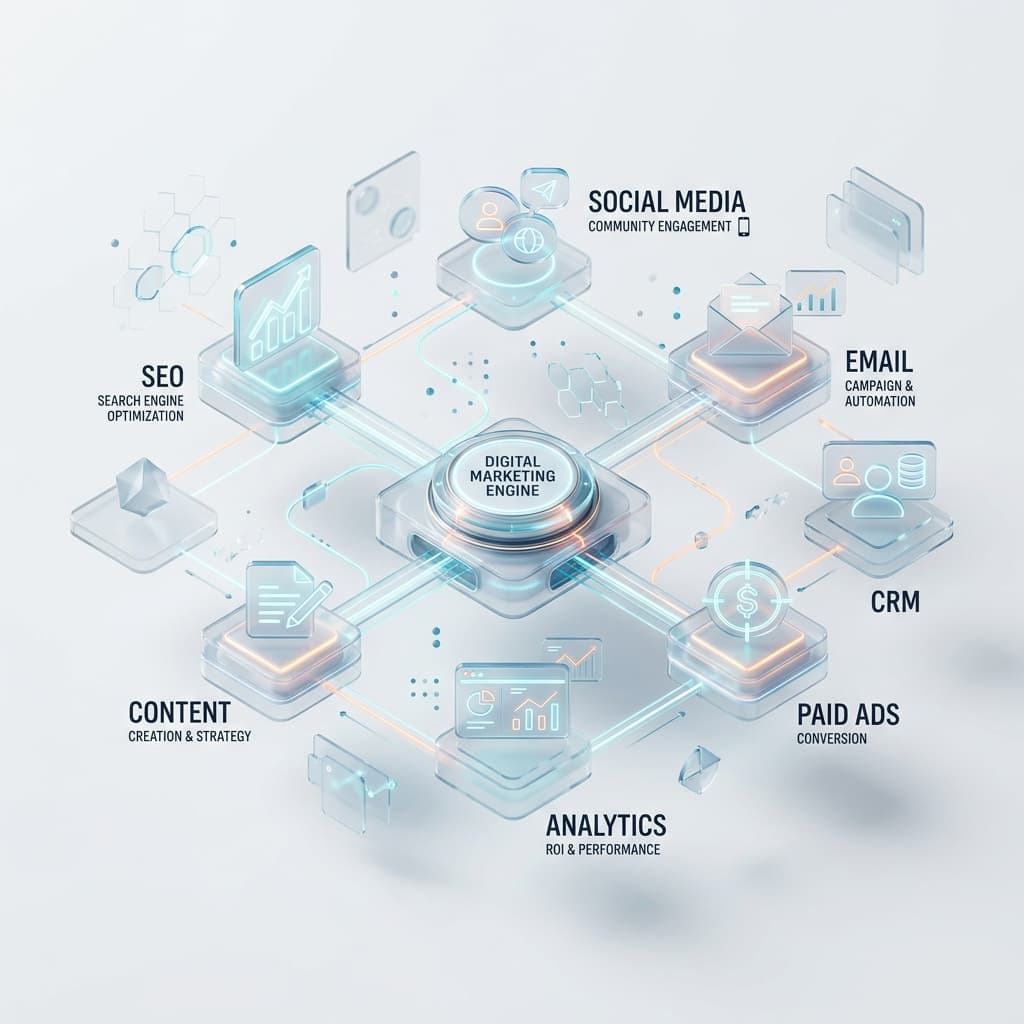
Let’s be honest for a second. If your current marketing strategy feels like throwing spaghetti at a wall and praying something sticks—you’re not alone.
Most businesses today don't have a marketing strategy; they have a collection of random tactics. A Facebook ad campaign here, a haphazardly written blog post there, maybe a monthly newsletter if the team remembers to send it out. And when the end of the quarter rolls around, everyone sits in a meeting staring at uninspiring ROI numbers, wondering why the math isn't mathing.
Here’s where most people go wrong: They confuse the tools with the system. TikTok, SEO, Google Ads, email automation—these are just tools. A hammer is great, but a hammer without a blueprint won't build a house. It’ll just leave you with a lot of smashed thumbs.
If you want predictable, scalable growth, you need to stop playing around with disconnected tactics. You need a digital marketing system.
In this breakdown, we’re going to strip away the fluff and look at how to build an engine that actually drives business.
What Actually Is a Digital Marketing System?
A digital marketing system is an integrated, repeatable process designed to attract strangers, convert them into leads, and nurture them into paying customers—reliably and automatically.
It’s not just "doing marketing." It’s an ecosystem where every piece communicates with the others.
- When your Facebook Ad runs, it drives traffic to a specific landing page.
- That landing page is optimized for conversions (UX).
- If they bounce, they are captured by a retargeting pixel.
- If they convert, they enter an automated email sequence.
- That email sequence delivers value and eventually pitches your core offer.
Every step has a purpose. There are no dead ends.
Quick check: Are you doing this?
Take a look at your last three marketing activities. Did they feed into a larger funnel, or were they isolated events? If you published a blog post but didn't have a specific lead capture mechanism attached to it, you’re leaking traffic.
Phase 1: The Foundation (Don't Skip This)
You cannot scale chaos. Before you spend a single dollar on ads or write another piece of content, you need to nail your foundation.
1. The Offer and The Positioning
Who are you helping, and what exact problem are you solving? Your product or service needs to be positioned in a way that makes it a no-brainer for your specific target audience. If your positioning is weak, the best digital marketing system in the world won’t save you.
Read Next: Branding vs Marketing: Why Most Businesses Get It Wrong
2. Your Website: The Conversion Hub
Your website is the heart of your digital marketing system. All roads lead here. If your site looks like it was built in 2012 and takes 6 seconds to load, your marketing budget is essentially being set on fire.
Your site needs:
- A clear value proposition above the fold: Within 3 seconds, a visitor should know what you do and why they should care.
- Fast load times: Google prioritizes speed. Users demand it.
- Optimized conversion pathways: Clear calls-to-action (CTAs) that guide the user exactly where you want them to go.
Phase 2: Traffic Generation (Feeding the Engine)
Once the foundation is solid and your website is ready to convert, it's time to turn on the faucet. But we don't want just any traffic; we want qualified eyeballs.
There are two primary engines for this in a robust digital marketing system.
We are long past the days of stuffing keywords into a 500-word article. Google rewards depth, relevance, and user experience. To understand how Google views your site's overall reputation, you should read my guide on Domain Authority (DA).
- Pillar Content: Comprehensive guides (like this one) that cover a broad topic in depth.
- Cluster Content: Smaller articles that answer specific questions and link back to your pillar content.
Read Next: SEO in 2026: AI, Search Intent & What Actually Works Now
The Paid Engine (PPC & Social Ads)
While SEO takes time, paid ads inject immediate speed into your system. The mistake most businesses make here is running conversion ads to cold traffic.
Instead, use paid ads strategically:
- Top of Funnel (Awareness): Promote high-value content or lead magnets to a targeted audience.
- Middle of Funnel (Retargeting): Show ads to people who visited your site but didn't convert. (This is often the highest ROI activity you can run).
- Bottom of Funnel (Conversion): Direct offers to people who have already engaged with your brand multiple times.
Phase 3: Lead Capture and Nurture (The Missing Link)
This is where 80% of companies drop the ball. They get traffic to the site, the user reads a page, and then... they leave.
If you aren't capturing contact information, your digital marketing system is broken. People rarely buy on the first interaction. You need a way to continue the conversation.
The Lead Magnet
Give them a reason to hand over their email address. "Subscribe to our newsletter" is a terrible pitch. No one wants more email.
Instead, offer:
- A cheat sheet or checklist.
- An exclusive industry report.
- A free mini-course or video training.
- A template they can use immediately.
Provide overwhelming value upfront.
The Automated Nurture Sequence
Once they opt-in, what happens? If you manually email them three weeks later, the lead is dead.
You need an automated email sequence that triggers immediately.
- Email 1 (Immediate): Deliver the lead magnet and set expectations.
- Email 2 (Day 2): Introduce your brand story and why you do what you do.
- Email 3 (Day 4): Provide a high-value piece of advice or a case study.
- Email 4 (Day 6): Address common objections or FAQs.
- Email 5 (Day 8): The soft pitch. Invite them to a consultation, a demo, or to make a purchase.
Phase 4: Measurement and Optimization (The Feedback Loop)
A digital marketing system is never "finished." It requires constant tuning. If you aren't measuring your performance, you are flying blind.
Focus on the metrics that actually matter:
- Customer Acquisition Cost (CAC): How much does it cost you to acquire a new paying customer?
- Lifetime Value (LTV): How much revenue does a customer bring in over their entire relationship with you?
- Conversion Rates: What percentage of website visitors become leads? What percentage of leads become customers?
Bringing It All Together
Building a comprehensive digital marketing system isn’t an overnight job. It takes strategy, patience, and a willingness to look at the big picture rather than getting distracted by the newest shiny object on social media.
Let's do a final self-check:
- Do you have a clear way to turn anonymous traffic into identifiable leads?
- Are you actively nurturing those leads without manual intervention?
- Do you know your exact cost to acquire a customer?
If you answered "no" to any of those, you have gaps in your system.
Ready to stop guessing and start scaling? If you’re tired of random tactics and want to build a high-performing digital marketing system tailored to your business, it’s time to look at your entire digital footprint. Let's talk about your system.
Tags