Core Web Vitals Explained: LCP, FID, and CLS
Understand Google's Core Web Vitals and how they impact your website's user experience and search rankings.
What are Core Web Vitals?
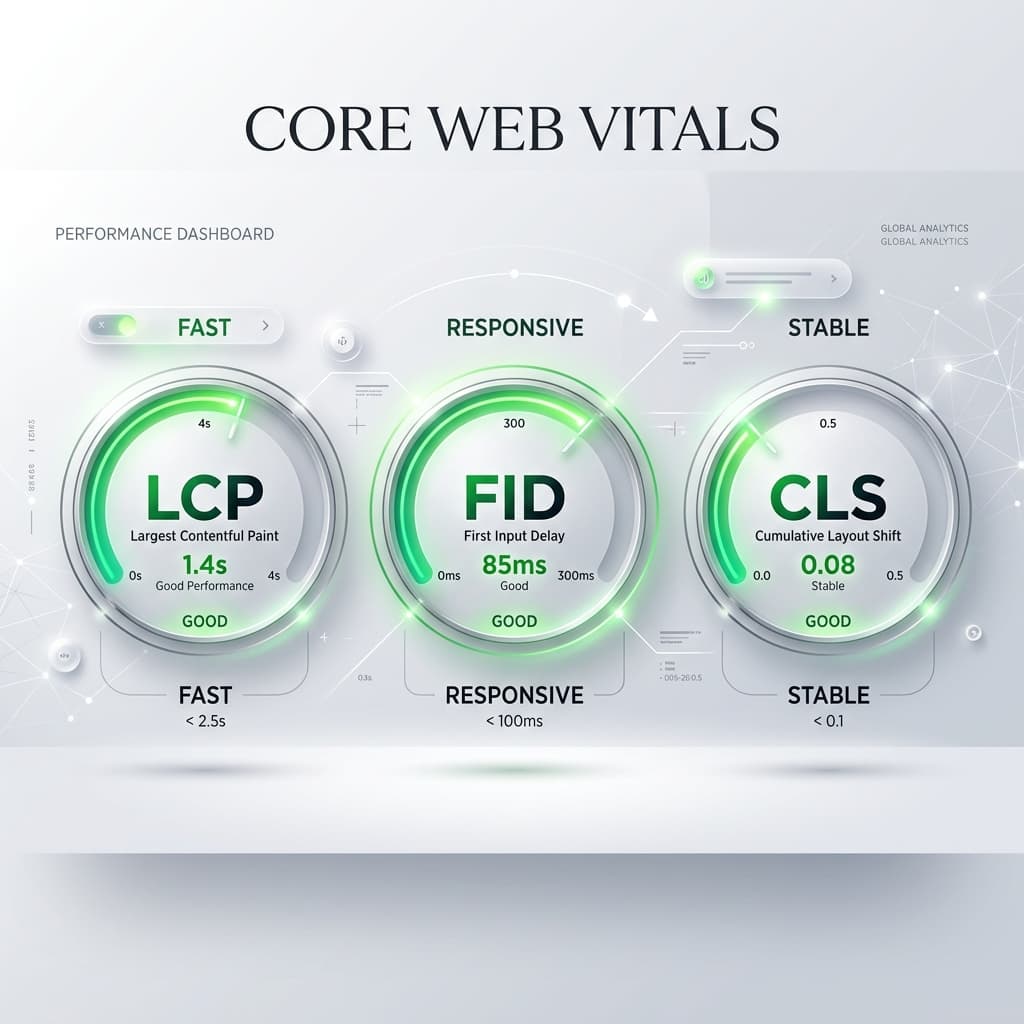
Core Web Vitals are a set of specific factors that Google considers important in a webpage's overall user experience. They are made up of three specific page speed and user interaction measurements: Largest Contentful Paint (LCP), First Input Delay (FID), and Cumulative Layout Shift (CLS).
In short, Core Web Vitals are a subset of factors that will be part of Google's "page experience" score (basically, Google's way of size-upping your page's overall UX).
The Three Pillars of Core Web Vitals
1. Largest Contentful Paint (LCP)
LCP measures loading performance. To provide a good user experience, LCP should occur within 2.5 seconds of when the page first starts loading.
- Common issues: Slow server response times, render-blocking JavaScript and CSS, and slow resource load times.
2. First Input Delay (FID)
FID measures interactivity. To provide a good user experience, pages should have an FID of 100 milliseconds or less.
- Common issues: Long tasks on the main thread, large JavaScript execution, and third-party scripts.
3. Cumulative Layout Shift (CLS)
CLS measures visual stability. To provide a good user experience, pages should maintain a CLS of 0.1 or less.
- Common issues: Images without dimensions, ads/embeds/iframes without dimensions, and dynamically injected content.
How to Measure Core Web Vitals
You can find your Core Web Vitals data in several Google tools:
- Google Search Console: The "Core Web Vitals" report shows how your pages perform based on real-world data (CrUX).
- PageSpeed Insights: Provides both lab data and field data for a specific URL.
- Chrome DevTools: The "Lighthouse" and "Performance" tabs help you debug issues locally.
Need help optimizing your site's performance? Let's build a faster web together.